Brandschutz6 Min Lesezeit

Fire Extinguisher Inspection Protocol Template – Digital Maintenance Log

With our digital fire extinguisher inspection and maintenance protocol, service technicians and fire safety officers record all inspection steps directly on-site using a smartphone or tablet. Ensure seamless, standardized documentation without the paperwork.

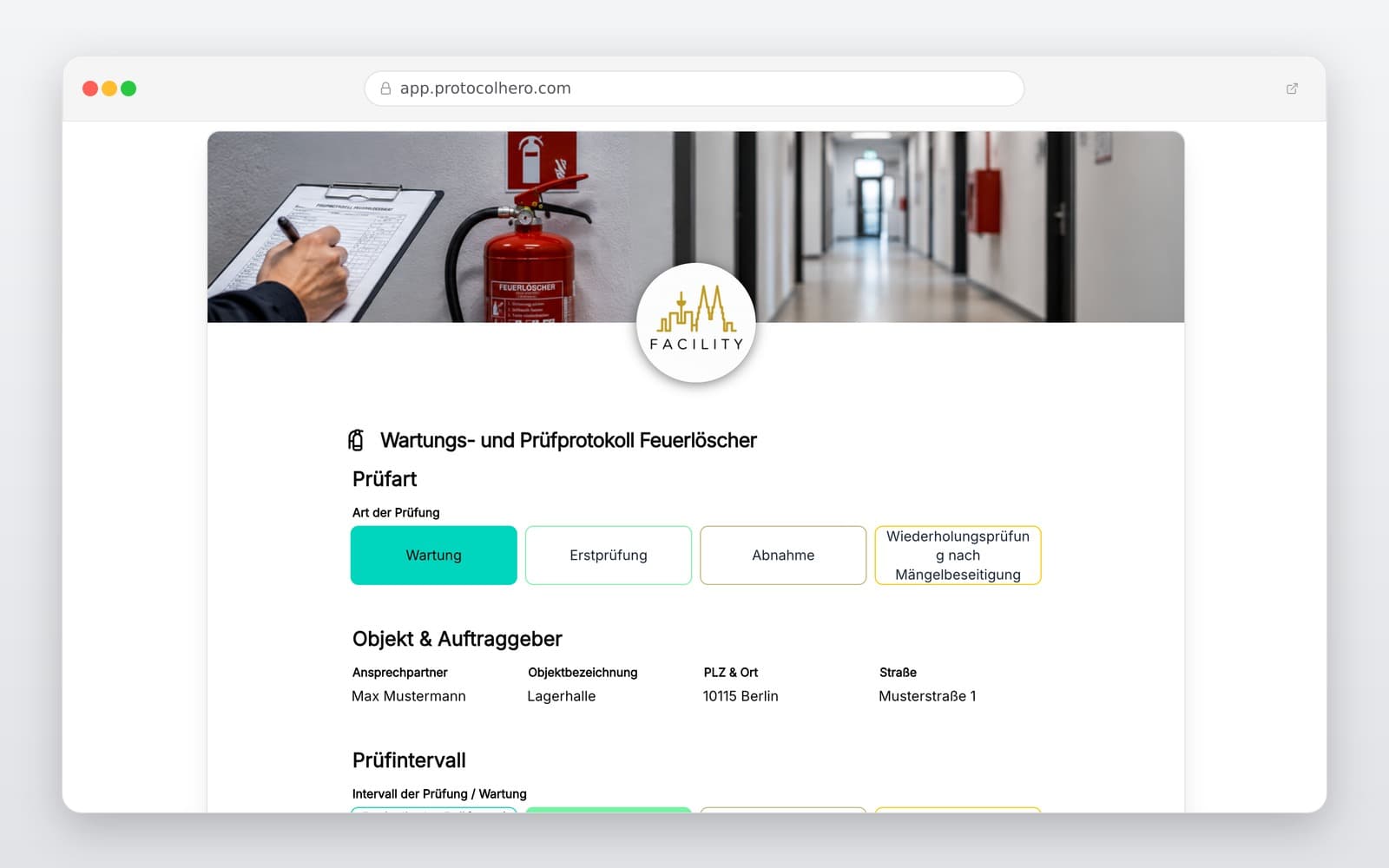
Preview of the “Fire Extinguisher Inspection Protocol Template – Digital Maintenance Log” template
Create free account
Inhalt der Vorlage

What is included in the inspection protocol template?

Customer, property, precise location, and inspection date

Unique identification of the fire extinguisher (manufacturer, type, year, serial number)

Specification of extinguishing agent (powder, foam, CO2, water) and capacity

Visual inspection of external condition and checking for corrosion

Check of safety pin, valves, hose assembly, nozzle, and pressure gauge

Documentation of defects, operational readiness, and maintenance actions performed

Conclusion with qualified inspector details, overall result, and next inspection date

Live form

Fill out this template directly in the browser

No install needed — complete the form below, attach photos, and submit. Create a free account anytime to save and reuse your own templates.

Document Fire Extinguisher Inspections Digitally Now

Use our interactive template and generate professional PDF reports directly on-site.

What belongs in a professional fire extinguisher inspection protocol?

A fire extinguisher inspection must be documented in a traceable and complete manner for customers, authorities, and insurance companies. In addition to general details such as customer, property, floor, and the exact location within the building, each fire extinguisher must be uniquely identifiable. This includes the manufacturer, model, type of extinguishing agent, year of manufacture, and the individual serial number.

During the actual inspection, the technical and physical condition of the device is assessed in detail. Relevant components such as the pressure vessel, valves, safety devices, hose assemblies, nozzles, and proper labeling must be checked for damage, cracks, and corrosion. Safety standards emphasize that regular maintenance and testing of functionality and safety, in compliance with relevant regulations and manufacturer instructions, are mandatory for reliable operation.

Any detected defects and all maintenance or repair measures carried out on-site (such as replacing seals or hoses) must be documented precisely in the protocol to provide seamless proof of operational readiness.
How often do fire extinguishers need to be inspected and serviced?

For fire extinguishers in commercial workplaces, workplace safety regulations (such as the German ASR A2.2, updated in 2025) and international standards specify the technical requirements for preventive fire protection.

To ensure constant operational readiness, regulations generally require a regular maintenance interval of at least every two years by a qualified expert. This two-year interval is a central guideline in commercial environments. However, it is crucial to understand that shorter inspection intervals may be necessary if required by the manufacturer's specifications or if the devices are exposed to harsh environmental factors, vibration, chemical exposure, or extreme temperatures.

Our template helps you flexibly define and transparently document the next inspection date based on individual requirements and manufacturer guidelines.

Avoid these typical mistakes in fire safety documentation

In the daily routine of fire protection companies and facility managers, manual paper documentation often leads to errors that can cause issues during audits or insurance claims. Typical pitfalls include:

• Missing or inaccurate location details: A serviced extinguisher cannot be found in the building.

• Missing serial numbers: The documentation cannot be legally or physically matched to the specific device.

• Verbal-only defect reporting: Identified defects are only communicated verbally to the client, leaving no proof of the technician's duty to inform.

• Incomplete history: Performed repairs or the next inspection dates are not recorded.

Simply taking photos of damages is also of little use if those photos remain on the technician's mobile phone instead of being linked directly to the specific device and inspection report. Especially for larger commercial properties with dozens of fire extinguishers, structured digital recording on-site is essential.

Digital workflows for fire protection experts

Optimize your entire on-site workflow with ProtocolHero's digital solution. A realistic everyday example shows the benefit: A service technician enters a commercial property for annual maintenance. The building contains various powder, foam, and CO₂ fire extinguishers. He opens the digital inspection protocol on his tablet, selects the property, and records the first device.

While checking a foam extinguisher, he notices a damaged hose. He immediately takes a photo of the defect using his mobile device's camera, attaches it to the protocol item, replaces the hose, and logs the repair measure digitally. After successfully completing the inspection, he records the result and the next inspection date. The customer signs directly on the screen, and the PDF is generated automatically.

Please note: A quick visual check by employees does not replace professional servicing. Standards require comprehensive maintenance and inspection by qualified persons. Our template is designed to structure and document these qualified maintenance activities – it does not, however, replace the required qualification of the inspector.

Häufige Fragen

Fragen zur Vorlage „Fire Extinguisher Inspection Protocol Template"

Mehr als eine Vorlage

Was ProtocolHero zusätzlich für dich übernimmt

Eine Vorlage allein ist erst der Anfang – ProtocolHero macht aus jedem Protokoll einen durchgängigen digitalen Workflow mit KI-Unterstützung, Workflow-Freigaben und revisionssicherem Archiv.

HERO Assistant – KI-Chat für Dokumentenerstellung

Der HERO Assistant ist der eingebaute KI-Chat von ProtocolHero. Du kannst per Spracheingabe ein komplettes Dokument anlegen lassen oder ein bestehendes PDF, Foto oder Word-Dokument hochladen – die KI liest die Struktur aus und baut eine wiederverwendbare Vorlage daraus.

Auto-Fill aus Sprache, Foto und Datei

Beim Ausfüllen kannst du das Dokument per Sprachsteuerung diktieren – die KI ordnet die Inhalte automatisch den richtigen Feldern zu. Oder du lädst Fotos, Scans, Verträge, Datenblätter oder Ausweise hoch: Der HERO Assistant extrahiert die Daten und befüllt das Formular vor – du prüfst und unterschreibst.

Foto- und Video-Upload direkt im Dokument

Zu jedem Bauteil, Messpunkt oder Schadensbild kannst du Fotos und Videos direkt aus der App anhängen. Videos sind besonders nützlich, wenn ein Schadensbild dynamisch ist – ein einzelnes Standbild würde den Befund nicht ausreichend dokumentieren.

Kommentare als Aufgaben – intern und mit dem Kunden

Jede Position im Dokument kann kommentiert und als Aufgabe an einen Kollegen, an dich selbst oder direkt an den Kunden zugewiesen werden. Kommentare können wahlweise rein intern bleiben oder im freigegebenen Kundenlink mitgeteilt werden.

Workflow: Bearbeiter zuweisen, Prüfer freigeben

Dokumente lassen sich an Kollegen weiterleiten und können einen festen Prüfer haben, der die letzte fachliche Freigabe erteilt, bevor das Dokument unterschrieben oder an den Kunden geht.

Activity-Log für lückenlose Nachvollziehbarkeit

Jedes Dokument hat einen vollständigen Aktivitäts-Verlauf: Wer hat wann was geändert, kommentiert, hochgeladen, freigegeben, unterschrieben. Das Log ist auf Wunsch auch im Kunden-Freigabelink sichtbar – ideal für Auditoren, Versicherer und Kunden.

Eindeutige Protocol-ID je Dokument

Jedes Dokument bekommt automatisch eine eindeutige Protocol-ID, mit der es sich zweifelsfrei referenzieren, verlinken und im Audit-Trail wiederfinden lässt.

Automatische Berichts-Nummerierung

Neu

Fortlaufende, lückenlose Berichts-Nummern (z. B. Protokoll-2026-001, 002, 003 …) je Dokumenttyp und Kunde – ohne manuelles Vergeben, ohne Dubletten.

Web-Formular & Inbox

Neu

Vorlagen lassen sich als öffentliches Web-Formular auf der eigenen Website einbinden – ein ausgefülltes Dokument landet automatisch in deiner ProtocolHero-Inbox zur Weiterbearbeitung.

QR-Code-Etiketten für Anlagen und Bauteile

Neu

QR-Code-Etiketten pro Anlage, Bauteil oder Abschottung, die beim Scannen direkt das hinterlegte Protokoll, die Historie und alle Wartungs- bzw. Prüfdokumente öffnen.

0 × genutzt

Diese Vorlage in 2 Minuten selbst nutzen

Vorlage übernehmen, an deinen Betrieb anpassen und direkt vor Ort ausfüllen – kostenlos testen, keine Kreditkarte nötig.