Fuhrpark & Verwaltung6 Min Lesezeit

Cargo Securing Checklist – Template for Trucks & Vans

Inadequate cargo securing compromises road safety and can lead to severe fines and transport damage. With our digital load securing checklist, drivers, loaders, and fleet managers can inspect all safety factors directly at the vehicle. Document the condition of cargo and securing equipment seamlessly via smartphone or tablet.

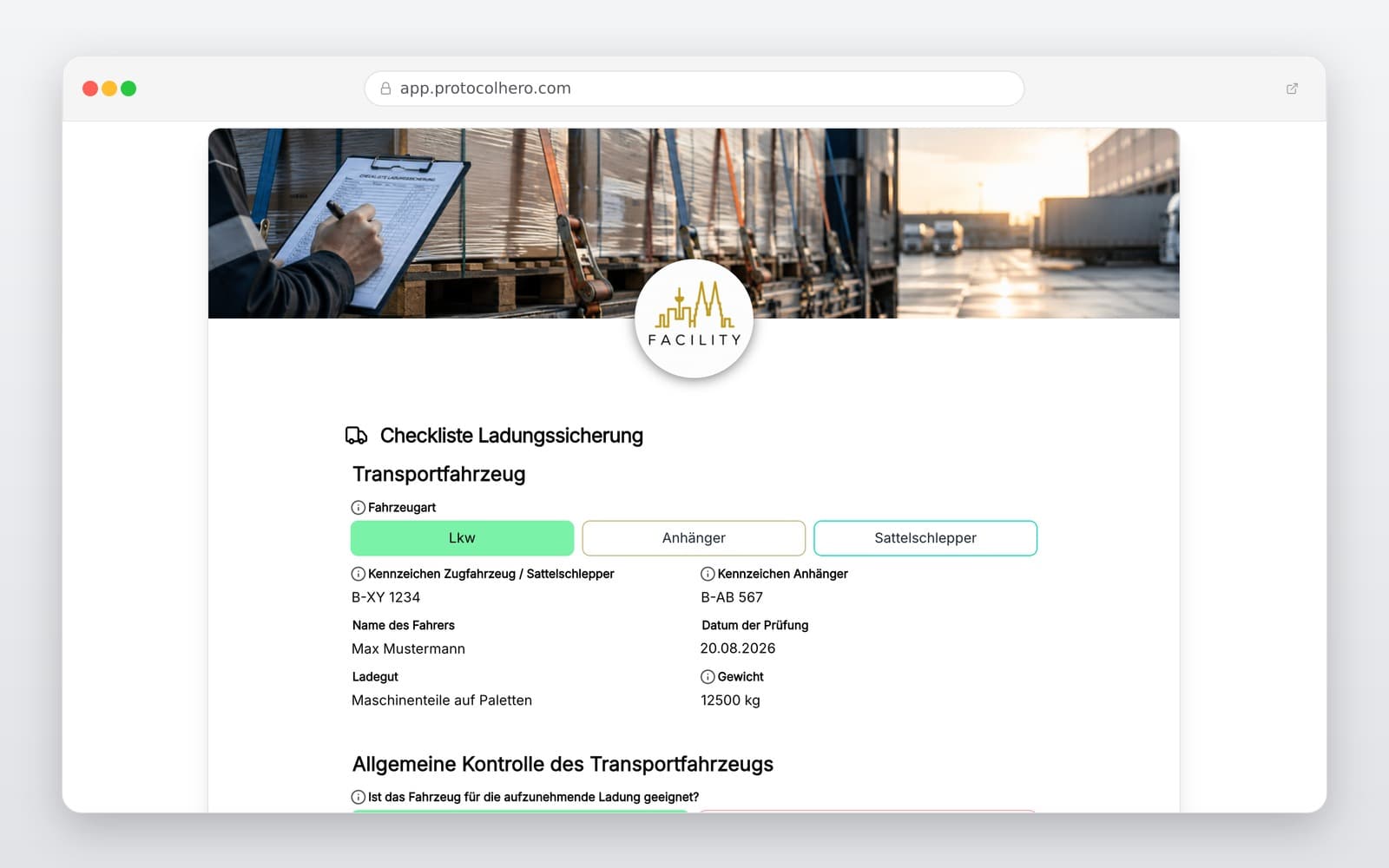
Preview of the “Cargo Securing Checklist – Template for Trucks & Vans” template
Create free account
Inhalt der Vorlage

What is included in the cargo securing template?

Vehicle, driver, date, and transport details

Details regarding the cargo and transported goods

Inspection of weight, permissible total mass, and load distribution

Check of loading area, vehicle body, and lashing points

Inspection of lashing equipment (e.g., tie-down straps, anti-slip mats)

Assessment of securing method (form-locking and force-locking)

Photo documentation of irregularities or defects

Completion of the inspection with a digital signature

Live form

Fill out this template directly in the browser

No install needed — complete the form below, attach photos, and submit. Create a free account anytime to save and reuse your own templates.

Complete the Cargo Securing Checklist Digitally at the Vehicle

Use our mobile-friendly template on your smartphone and try ProtocolHero completely free of charge.

What belongs in a professional cargo securing checklist?

A reliable load securing inspection starts long before the first lashing straps are tightened. First, it must be verified whether the vehicle and loading surface are generally suitable for the specific cargo. Load distribution is a critical factor here: incorrect weight distribution severely impairs vehicle handling. Safety associations recommend avoiding one-sided loading, keeping the cargo's center of gravity as low as possible, and strictly adhering to permissible axle loads and total weight limits.

Next, the securing equipment itself comes into focus. Depending on the cargo, lashing straps, chains, anti-slip mats, blocking bars, or nets must be checked for functionality. The vehicle's lashing points, loading surface, and structure must also show no visible defects. Finally, the inspection must be documented transparently so that all parties involved can verify that the load was secured correctly.
Legal Requirements: Road Traffic Regulations and Technical Guidelines

Under German road traffic regulations (§ 22 Section 1 StVO), cargo and securing equipment must be stowed and secured so that they cannot slide, fall over, roll, or drop, even during emergency braking or sudden evasive maneuvers. Furthermore, § 23 StVO requires the driver to ensure the vehicle's roadworthiness before departure.

Crucially, responsibility does not lie solely with the driver. Depending on the loading process and company organization, loaders, vehicle owners, and dispatchers also share significant liabilities. The VDI 2700 guideline series ('Cargo securing on road vehicles') serves as the recognized rule of technology. For lighter commercial vehicles and vans up to 7.5 tons, VDI 2700 Sheet 16 (introduced in June 2026) provides the relevant working standard.

Avoiding Common Mistakes in Load Securing

Many pitfalls exist in daily operations. Frequently, lashing straps with visible tears or damage are still used. Unchecked lashing points or poor load distribution (such as placing heavy items on top of fragile cargo) also compromise safety. Another common misconception is relying solely on the number of straps. Adequate securing must always be calculated individually based on cargo weight, friction coefficients, securing methods, and vehicle body type.

According to safety regulations, all securing devices must be fully functional. A superficial check marked simply with 'cargo secured' is not enough in the event of an accident. With ProtocolHero's digital template, you can capture defects like worn-out straps via photo immediately so they can be replaced before departure.

Form-locking vs. Force-locking Securing Simply Explained

There are two primary methods of securing cargo, which are often combined in practice:

Form-locking (formschlüssige) securing occurs when the cargo is packed tightly against the vehicle walls or blocked with bars, wedges, or dunnage bags, leaving no empty spaces for movement.

Force-locking (kraftschlüssige) securing utilizes friction. By tie-down lashing, the downward force increases the friction between the cargo and the loading floor. Using anti-slip mats is one of the most effective ways to maximize friction and reduce the number of required straps.

Please note: There is no generic rule for how many lashing straps are sufficient. The required securing must always be calculated specifically based on the cargo, weight, and securing method.

Load Securing for Vans and Handyman Vehicles

Load securing is not just an issue for heavy long-haul trucks. Craft businesses, service technicians, and delivery services also transport heavy tools, machinery, gas cylinders, or building materials in vans and box trucks every day.

The same rules apply here: unsecured cargo becomes a life-threatening projectile during emergency braking. For vans and commercial vehicles up to 7.5 tons maximum permissible weight, the VDI 2700 Sheet 16 guideline provides specific requirements for securing loads.

Digital Workflow: Documenting Load Securing Directly at the Vehicle

With ProtocolHero's cloud-based solution, inspections are fast and paperless. The driver or loader opens the checklist on their smartphone, records the vehicle and cargo, and completes the checklist step-by-step.

A realistic example from logistics: A truck is loaded with mechanical components in the morning. Before departure, the responsible employee checks the load distribution and the lashing straps. A damaged strap is noticed. The strap is immediately sorted out, the defect is documented via photo in the app, and the load is secured with an intact strap. After completing the check, the proper securing is fully documented—without any paperwork in the driver's cab.

Tip: Combine this template with your daily truck pre-trip inspection (Abfahrtkontrolle) to bundle all pre-departure tasks into one seamless digital workflow.

Häufige Fragen

Fragen zur Vorlage „Cargo Securing Checklist"

Mehr als eine Vorlage

Was ProtocolHero zusätzlich für dich übernimmt

Eine Vorlage allein ist erst der Anfang – ProtocolHero macht aus jedem Protokoll einen durchgängigen digitalen Workflow mit KI-Unterstützung, Workflow-Freigaben und revisionssicherem Archiv.

HERO Assistant – KI-Chat für Dokumentenerstellung

Der HERO Assistant ist der eingebaute KI-Chat von ProtocolHero. Du kannst per Spracheingabe ein komplettes Dokument anlegen lassen oder ein bestehendes PDF, Foto oder Word-Dokument hochladen – die KI liest die Struktur aus und baut eine wiederverwendbare Vorlage daraus.

Auto-Fill aus Sprache, Foto und Datei

Beim Ausfüllen kannst du das Dokument per Sprachsteuerung diktieren – die KI ordnet die Inhalte automatisch den richtigen Feldern zu. Oder du lädst Fotos, Scans, Verträge, Datenblätter oder Ausweise hoch: Der HERO Assistant extrahiert die Daten und befüllt das Formular vor – du prüfst und unterschreibst.

Foto- und Video-Upload direkt im Dokument

Zu jedem Bauteil, Messpunkt oder Schadensbild kannst du Fotos und Videos direkt aus der App anhängen. Videos sind besonders nützlich, wenn ein Schadensbild dynamisch ist – ein einzelnes Standbild würde den Befund nicht ausreichend dokumentieren.

Kommentare als Aufgaben – intern und mit dem Kunden

Jede Position im Dokument kann kommentiert und als Aufgabe an einen Kollegen, an dich selbst oder direkt an den Kunden zugewiesen werden. Kommentare können wahlweise rein intern bleiben oder im freigegebenen Kundenlink mitgeteilt werden.

Workflow: Bearbeiter zuweisen, Prüfer freigeben

Dokumente lassen sich an Kollegen weiterleiten und können einen festen Prüfer haben, der die letzte fachliche Freigabe erteilt, bevor das Dokument unterschrieben oder an den Kunden geht.

Activity-Log für lückenlose Nachvollziehbarkeit

Jedes Dokument hat einen vollständigen Aktivitäts-Verlauf: Wer hat wann was geändert, kommentiert, hochgeladen, freigegeben, unterschrieben. Das Log ist auf Wunsch auch im Kunden-Freigabelink sichtbar – ideal für Auditoren, Versicherer und Kunden.

Eindeutige Protocol-ID je Dokument

Jedes Dokument bekommt automatisch eine eindeutige Protocol-ID, mit der es sich zweifelsfrei referenzieren, verlinken und im Audit-Trail wiederfinden lässt.

Automatische Berichts-Nummerierung

Neu

Fortlaufende, lückenlose Berichts-Nummern (z. B. Protokoll-2026-001, 002, 003 …) je Dokumenttyp und Kunde – ohne manuelles Vergeben, ohne Dubletten.

Web-Formular & Inbox

Neu

Vorlagen lassen sich als öffentliches Web-Formular auf der eigenen Website einbinden – ein ausgefülltes Dokument landet automatisch in deiner ProtocolHero-Inbox zur Weiterbearbeitung.

QR-Code-Etiketten für Anlagen und Bauteile

Neu

QR-Code-Etiketten pro Anlage, Bauteil oder Abschottung, die beim Scannen direkt das hinterlegte Protokoll, die Historie und alle Wartungs- bzw. Prüfdokumente öffnen.

0 × genutzt

Diese Vorlage in 2 Minuten selbst nutzen

Vorlage übernehmen, an deinen Betrieb anpassen und direkt vor Ort ausfüllen – kostenlos testen, keine Kreditkarte nötig.