

Digital protocols for solar and photovoltaics
From roof survey through commissioning and acceptance to annual maintenance — one protocol record per system, for installation teams, office and customers.
Bring an existing form. In the call we map your real workflow in ProtocolHero and show what the finished PDF looks like.
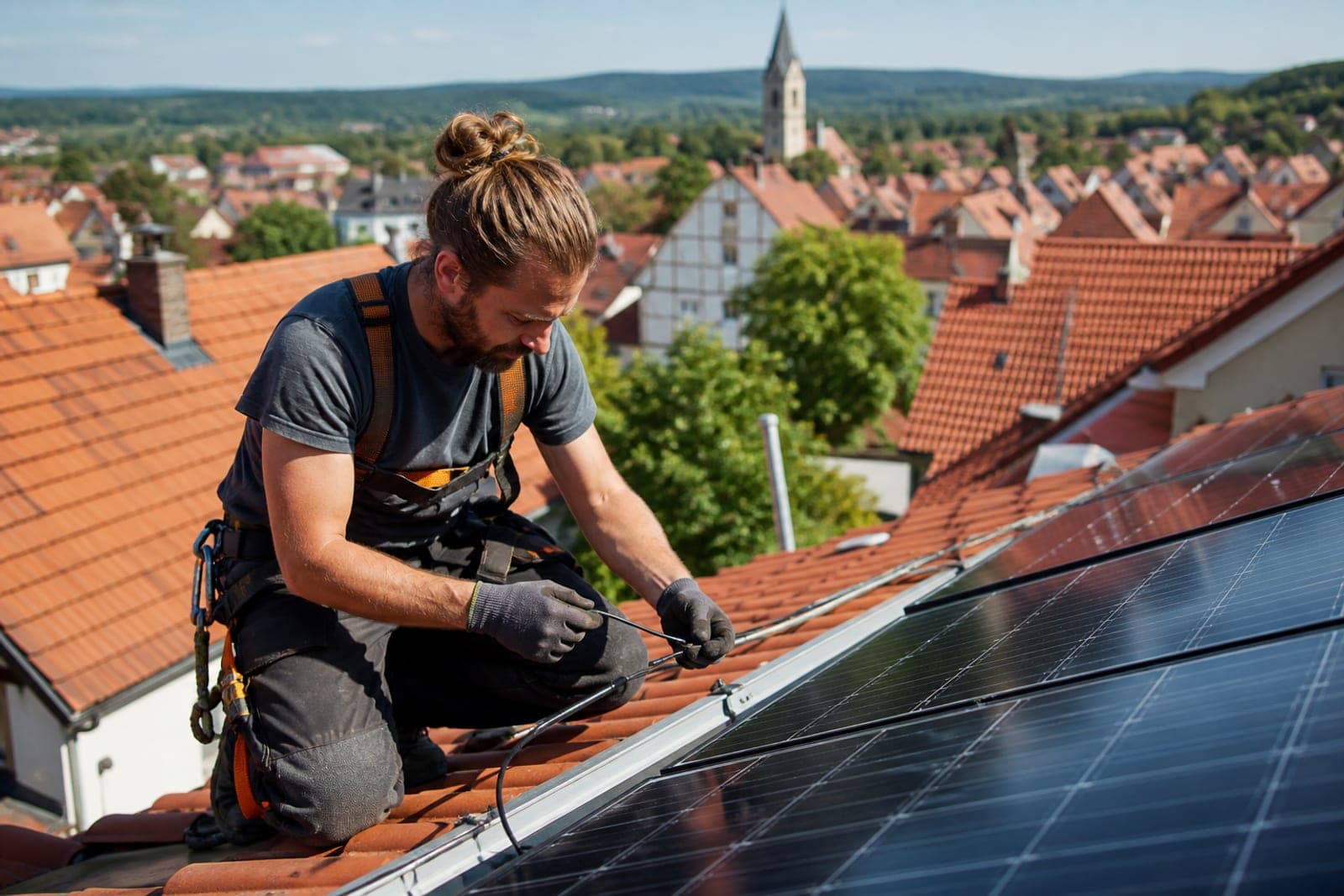
How Solar & photovoltaics document today – and what it costs
A PV system generates documents for years: roof survey, string plan, commissioning protocol with readings, acceptance with customer signature, documents for grid operator and subsidies, then annual maintenance. In many companies this is spread across crew chat groups, spreadsheets in the office and PDF attachments in mailboxes.
The result: acceptance drags on because documents are missing. String measurements are handwritten and transferred wrongly. At the maintenance three years later nobody knows the previous values. And when the customer complains about low yield, the company has to prove what was measured on commissioning day.
For the owner this is a growth problem: more systems mean more office work today. ProtocolHero reverses that — documentation is finished on the roof, and every system carries its history.
Who ProtocolHero is built for
- Solar installers and PV contractors with several installation crews
- Electrical and energy-technology companies installing PV, storage and wallboxes
- Maintenance and service providers with a portfolio of systems
- General contractors and project developers coordinating subcontractors
Four things that change for management
Not more forms, but less rework, less risk and a business you can show at any time.
Every system with a complete history
System, customer, components and all protocols are linked in your database. Per system you see what is done, what is in review and which maintenance is due — across all installation crews.
Readings per string, no transposed digits
Uoc, Isc, Riso per string as a row of a recurring block with plausibility limits. Photos of inverter and meter cabinet are read by the Hero Agent and entered into the protocol — the crew photographs instead of copying.
Acceptance on installation day, not weeks later
The customer signs on the tablet and automatically receives the link with PDF and attachments. Grid operator and subsidy documents are included because they are required fields of the template — no follow-ups, no payment delay.
The commissioning record is at hand for yield complaints
Approved protocol with timestamp, photos and readings proves what was measured on commissioning day. Warranty questions are answered with a link, not a search.
Schluss mit Word, Excel und Zettelwirtschaft
Diese typischen Hürden kennen Betriebe in Ihrem Gewerk – und genau hier setzt ProtocolHero an.
Roof survey, string plan and commissioning sit in three different files and chat groups.
Open-circuit voltage, insulation resistance and string currents are handwritten and later transferred wrongly.
Customer acceptance drags on because documents for grid operator and subsidies are delivered later.
With many systems nobody knows which maintenance is due and which defect is still open.
So unterstützt ProtocolHero Solar & photovoltaics
Vor Ort erfassen, im Team prüfen und freigeben, als PDF übergeben – digital, mobil und nachvollziehbar.
One protocol record per system
Site survey, commissioning, acceptance and maintenance are attached to the same system in your database — every inspection knows the previous readings.
Strings and modules as recurring blocks
One instance per string or inverter with voltage, current, insulation and photo — readings as a table instead of free text.
Photos and readings straight into the protocol
Your crew sends photos of the inverter or meter cabinet to the channel, the Hero Agent enters the values into the protocol and attaches the photo as evidence.
Acceptance and handover to the customer
The customer signs on site and automatically receives the link to the finished submission with PDF — grid operator and subsidy documents attached.
From template to proof
One continuous process instead of isolated tools – identical for every team, with clear ownership per step.
- 1
Templates for the life cycle
Site survey, commissioning, acceptance, maintenance — maintained centrally, with required fields for grid operator and subsidy documents.
- 2
Create the system in the database
Customer, address, modules, inverter, storage. Every protocol is assigned to the system and knows the previous values.
- 3
Crew documents on the roof
String measurements, photos, serial numbers — offline on the tablet. Photos from the team channel are transferred into the protocol by the Hero Agent.
- 4
Review and approval in the office
The responsible electrician checks readings and completeness and approves. Missing data is requested before acceptance, not after.
- 5
Acceptance with the customer
Signature on site, automatic link with PDF download and attachments. Open items land as a board card with owner and deadline.
- 6
Maintenance with previous values
Maintenance interval in the database; the Hero Agent reminds. During maintenance the commissioning values sit next to the current ones.
Where the money is left on the table today
Four crews complete 30 to 40 systems a month. If each system costs 45 minutes in the office for retyping readings, collecting photos, creating the acceptance and sending documents afterwards, that is roughly 25 to 30 hours a month — time in which nobody quotes new jobs.
The indirect effect is more expensive: every acceptance delayed two weeks by missing documents delays the final invoice. With ProtocolHero the customer signs on installation day because the protocol is complete before the crew leaves the roof.
- Record string measurements once, never retype — the Hero Agent reads photos
- Complete documents on installation day: faster acceptance, faster invoice
- Maintenance deadlines in view: recurring service revenue per system
- Commissioning proof with timestamp lowers warranty risk
Inspection protocols, maintenance reports, acceptances, fault reports
Retyping, matching photos, follow-ups, creating the PDF, filing
Review and approve – the rest is captured on site
Per year, office only
€64,800
20 minutes less office work per protocol × 4,320 protocols × €45/h
- 4,320
- protocols per year
- 1,440
- office hours saved per year
- 180
- working days (8 h) per year
Not included: fewer follow-ups on site, less rework, faster invoicing and the time you save when someone asks for proof. We measure the real numbers in the pilot.
Start a pilotReal customers, real statements
Solar contractor Hamacher Solar documents thousands of documents across five teams in ProtocolHero; further references come from electrical and energy-technology companies that create inspection and acceptance protocols directly on site.
„Bei uns gilt: Ohne vollständiges Protokoll zahlt der Kunde nicht. Angefangen haben wir mit dem Elektroteam, heute arbeiten Wärme, Dach, Vertrieb und Büro im selben System – tausende Dokumente, jedes geprüft und dem Richtigen zugewiesen. Und wenn wir etwas brauchen, ist das ProtocolHero-Team sofort da.“


„The first time I heard about ProtocolHero, I was excited about the vision from the very first minute – and today I'm proud that I got the product right away, as ProtocolHero's very first customer. I'm convinced that a product can only grow when we as businesses support one another – that's the only way to truly reduce the time our own customers have to spend. In the beginning a lot was new to me, but Steven, the managing director, always advised me kindly and responded to my own wishes right away. That's why we'll also be using ProtocolHero for our photovoltaic systems, heat pumps and other areas going forward. Many thanks to the whole team – and here's to a great future together!“

„Wir nutzen ProtocolHero inzwischen täglich, und es hat unsere Arbeitsprozesse deutlich vereinfacht. Besonders das KI-Feature spart uns sehr viel Zeit, weil wir nicht mehr alles händisch eintippen müssen. Gerade bei wiederkehrenden Aufgaben wie einem E-Check nimmt uns das System spürbar Arbeit ab. ProtocolHero ist wirklich selbsterklärend – man findet sich schnell zurecht.“

Beliebte Vorlagen für Solar & photovoltaics
Starten Sie mit fertigen Vorlagen oder bauen Sie sich Ihre eigenen – ganz ohne IT-Kenntnisse.
Fragen rund um Solar & photovoltaics
Note: ProtocolHero supports structured, traceable documentation. The professional assessment and the correct execution of inspections remain the responsibility of the executing company and its qualified personnel.
Das könnte Sie auch interessieren
See your Solar & photovoltaics workflow in ProtocolHero
In 15 minutes we clarify where time is lost today, whether ProtocolHero fits your process and team size, and how a real report of your business looks digitally. No generic product pitch.