Facility Management8

MRA Maintenance Log – Template for Mechanical Smoke Extraction Systems

Regular maintenance of mechanical smoke extraction systems (MRA) ensures vital escape routes in the event of a fire and protects property. With our digital MRA maintenance log template, specialized contractors, facility management teams, and fire safety officers can document all inspection steps on the go. Seamlessly record fans, measured values, and control units directly on-site.

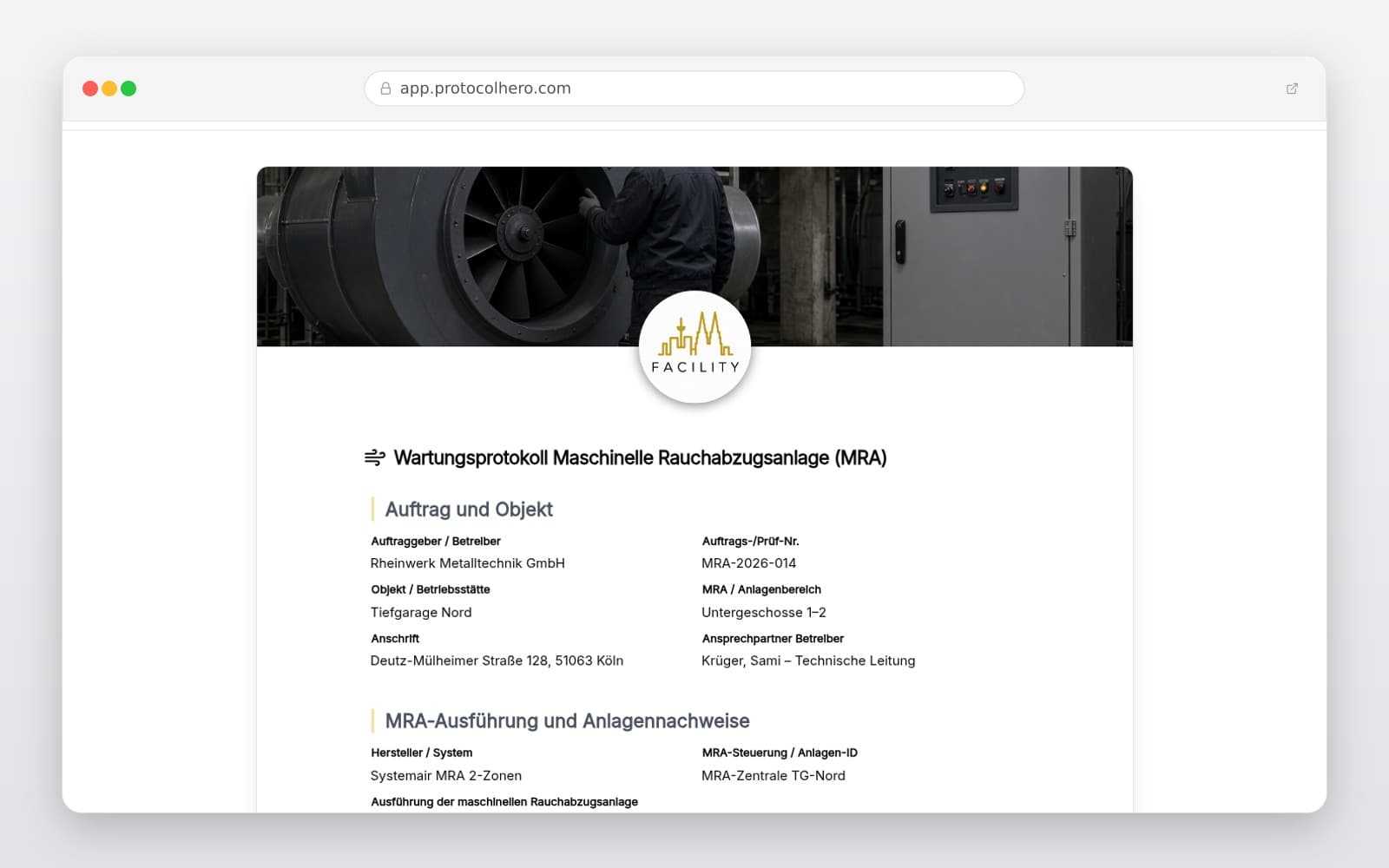
Preview of the “MRA Maintenance Log – Template for Mechanical Smoke Extraction Systems” template
Create free account

Short answer

What is the “MRA Maintenance Log – Template for Mechanical Smoke Extraction Systems” template for?

Fill out your MRA maintenance log digitally. Document mechanical smoke extraction systems, fans & controls in compliance with VDMA 24186-1.

Use case
Facility Management
Captured data
Clear assignment of client, object, system area, and inspection number, Recording of manufacturer, MRA control, system data, and smoke extraction zones, Comparison with fire protection concepts, functional matrices, logbooks, and manuals
Result
A structured form that can be completed directly in the browser and reused in ProtocolHero.

Check the template against the technical, contractual and legal requirements of the specific case. ProtocolHero does not replace professional assessment.

Inhalt der Vorlage

What is Included in the MRA Maintenance Log?

Clear assignment of client, object, system area, and inspection number

Recording of manufacturer, MRA control, system data, and smoke extraction zones

Comparison with fire protection concepts, functional matrices, logbooks, and manuals

Inspection of controls, visual/acoustic indicators, cable routes, and emergency power

Repeatable logging of smoke extraction fans including startup times and volume flows

Documentation of supply air systems, manual releases, fire alarm interfaces, and functions

Photo documentation of fans, airways, and identified defects directly on-site

Prioritized repair measures with assigned responsibilities, deadlines, and status tracking

Live form

Fill out this template directly in the browser

No install needed — complete the form below, attach photos, and submit. Create a free account anytime to save and reuse your own templates.

Document MRA Maintenance Digitally and Structurally

Use the ProtocolHero template to record controls, fans, measured values, airways, and defect reports on your mobile device.

1. Capture Order and MRA System Data

Professional documentation begins with the clear assignment of all property and system details. Before you start maintaining the mechanical smoke extraction system, record the specific key data of the installation as well as the legal and operational foundations.

This includes manufacturer details, system types, and assignment to the respective smoke extraction zones. By comparing this data with the fire protection concept, the functional matrix, and the existing inspection logbook, you ensure that the functional check is tailored precisely to the object-specific requirements.

  • Recording of object, system area, and individual inspection number
  • Documentation of manufacturer, control type, and smoke extraction zones
  • Verification of the presence of the logbook, functional matrix, and maintenance instructions
2. Inspect Control and Power Supply

The control unit is the brain of any smoke extraction system. If the power supply fails or the control unit reacts incorrectly, the entire system remains ineffective in an emergency. Therefore, this area forms a core part of the MRA maintenance log.

Check all housings, cable routes, visual and acoustic operating indicators, and the switching equipment for the emergency power supply. Seamless documentation of these system components provides operators with the assurance that the system will be reliably triggered in the event of a fire.

  • Visual and functional check of the MRA control panel and indicators
  • Inspection of cable routes for damage and proper installation
  • Testing of the emergency power supply (battery systems, emergency generators) for functionality

3. Document Fans, Airways, and Interfaces

The heart of mechanical smoke extraction is the fan system. During the smoke extraction fan inspection, all mechanical and electrical measured values must be precisely recorded. The template allows you to input repeatable measurement data for each fan and smoke extraction zone in a structured format.

This includes documenting flow velocities, volume flows, startup times, and electrical current consumption. At the same time, the interaction with the supply air routing, manual release buttons, and interfaces to the fire alarm system (FAS) is evaluated in detail during the functional test.

  • Measurement of startup times, volume flow, and electrical operating values per fan
  • Inspection of airways, damper positions, and supply air replenishment
  • Functional check of interfaces to the FAS and manual triggering devices

4. Evaluate Defects and Track Repairs

If deviations or defects are detected during the maintenance of the smoke extraction system, they must be documented and evaluated immediately. Structured defect management is crucial to minimize liability risks for operators and service contractors.

Use the integrated photo documentation to provide direct visual proof of defects. Each required repair measure is assigned a priority, a clear deadline, and a responsible person, ensuring that the status remains fully traceable until a successful re-inspection.

  • Visual recording of damages and defects using on-site photo documentation
  • Prioritization of repair measures based on urgency and safety relevance
  • Definition of deadlines, responsibilities, and documentation of the resolution status
Häufige Fragen

Fragen zur Vorlage „MRA Maintenance Log"

Mehr als eine Vorlage

Was ProtocolHero zusätzlich für dich übernimmt

Eine Vorlage allein ist erst der Anfang – ProtocolHero macht aus jedem Protokoll einen durchgängigen digitalen Workflow mit KI-Unterstützung, Workflow-Freigaben und revisionssicherem Archiv.

HERO Assistant – KI-Chat für Dokumentenerstellung

Der HERO Assistant ist der eingebaute KI-Chat von ProtocolHero. Du kannst per Spracheingabe ein komplettes Dokument anlegen lassen oder ein bestehendes PDF, Foto oder Word-Dokument hochladen – die KI liest die Struktur aus und baut eine wiederverwendbare Vorlage daraus.

Auto-Fill aus Sprache, Foto und Datei

Beim Ausfüllen kannst du das Dokument per Sprachsteuerung diktieren – die KI ordnet die Inhalte automatisch den richtigen Feldern zu. Oder du lädst Fotos, Scans, Verträge, Datenblätter oder Ausweise hoch: Der HERO Assistant extrahiert die Daten und befüllt das Formular vor – du prüfst und unterschreibst.

Foto- und Video-Upload direkt im Dokument

Zu jedem Bauteil, Messpunkt oder Schadensbild kannst du Fotos und Videos direkt aus der App anhängen. Videos sind besonders nützlich, wenn ein Schadensbild dynamisch ist – ein einzelnes Standbild würde den Befund nicht ausreichend dokumentieren.

Kommentare als Aufgaben – intern und mit dem Kunden

Jede Position im Dokument kann kommentiert und als Aufgabe an einen Kollegen, an dich selbst oder direkt an den Kunden zugewiesen werden. Kommentare können wahlweise rein intern bleiben oder im freigegebenen Kundenlink mitgeteilt werden.

Workflow: Bearbeiter zuweisen, Prüfer freigeben

Dokumente lassen sich an Kollegen weiterleiten und können einen festen Prüfer haben, der die letzte fachliche Freigabe erteilt, bevor das Dokument unterschrieben oder an den Kunden geht.

Activity-Log für lückenlose Nachvollziehbarkeit

Jedes Dokument hat einen vollständigen Aktivitäts-Verlauf: Wer hat wann was geändert, kommentiert, hochgeladen, freigegeben, unterschrieben. Das Log ist auf Wunsch auch im Kunden-Freigabelink sichtbar – ideal für Auditoren, Versicherer und Kunden.

Eindeutige Protocol-ID je Dokument

Jedes Dokument bekommt automatisch eine eindeutige Protocol-ID, mit der es sich zweifelsfrei referenzieren, verlinken und im Audit-Trail wiederfinden lässt.

Automatische Berichts-Nummerierung

Neu

Fortlaufende, lückenlose Berichts-Nummern (z. B. Protokoll-2026-001, 002, 003 …) je Dokumenttyp und Kunde – ohne manuelles Vergeben, ohne Dubletten.

Web-Formular & Inbox

Neu

Vorlagen lassen sich als öffentliches Web-Formular auf der eigenen Website einbinden – ein ausgefülltes Dokument landet automatisch in deiner ProtocolHero-Inbox zur Weiterbearbeitung.

QR-Code-Etiketten für Anlagen und Bauteile

Neu

QR-Code-Etiketten pro Anlage, Bauteil oder Abschottung, die beim Scannen direkt das hinterlegte Protokoll, die Historie und alle Wartungs- bzw. Prüfdokumente öffnen.

587 × genutzt

Diese Vorlage in 2 Minuten selbst nutzen

Vorlage übernehmen, an deinen Betrieb anpassen und direkt vor Ort ausfüllen – kostenlos testen, keine Kreditkarte nötig.