Fuhrpark & Verwaltung8

UVV Vehicle Inspection Template – Checklist according to DGUV Regulation 70

The regular operational vehicle inspection according to DGUV Regulation 70 is a statutory requirement for every commercial fleet. With this digital template, you can document the condition of your vehicles seamlessly and in compliance with safety standards. Record defects, inspection intervals, and approvals directly on-site using a smartphone or tablet.

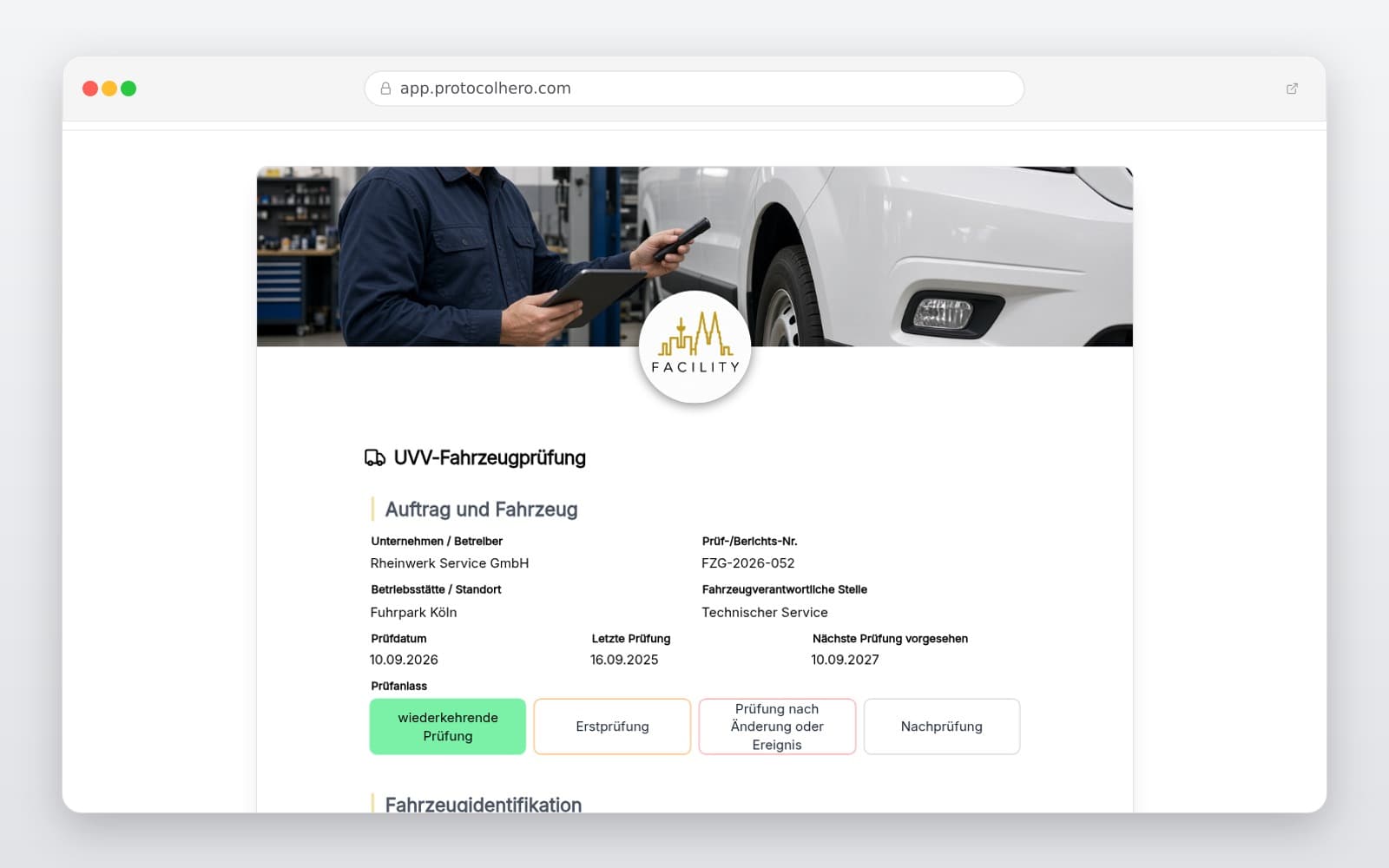
Preview of the “UVV Vehicle Inspection Template – Checklist according to DGUV Regulation 70” template
Create free account

Short answer

What is the “UVV Vehicle Inspection Template – Checklist according to DGUV Regulation 70” template for?

Document your UVV vehicle inspection legally and securely. Template for the inspection protocol according to DGUV Regulation 70. Start your digital audit now!

Use case
Fuhrpark & Verwaltung
Captured data
Master Data: Company, location, vehicle identification number (VIN), and license plate, Vehicle Details: Manufacturer, model, mileage, and gross vehicle weight, Inspection Basis: Qualification of the competent person, legal standards (DGUV V 70, BetrSichV)
Result
A structured form that can be completed directly in the browser and reused in ProtocolHero.

Check the template against the technical, contractual and legal requirements of the specific case. ProtocolHero does not replace professional assessment.

Inhalt der Vorlage

What is Included in the UVV Vehicle Inspection Protocol?

Master Data: Company, location, vehicle identification number (VIN), and license plate

Vehicle Details: Manufacturer, model, mileage, and gross vehicle weight

Inspection Basis: Qualification of the competent person, legal standards (DGUV V 70, BetrSichV)

Technical Inspection: Chassis, brakes, steering, wheels, and tires

Safety Inspection: Driver's seat, visibility, and mandatory safety equipment

Body & Cargo: Evaluation of vehicle body, load securing, and auxiliary equipment

Defect Assessment: Classification of defects, deadlines, and corrective actions

Sign-off & Proof: Signatures of the inspector and fleet manager for compliance

Live form

Fill out this template directly in the browser

No install needed — complete the form below, attach photos, and submit. Create a free account anytime to save and reuse your own templates.

Create Your Digital UVV Vehicle Inspection Protocol Now

Structure your vehicle data, inspection scope, and defects systematically to provide seamless proof of your fleet's operational safety.

Determine Inspection Scope and Intervals Based on Risk

Legal regulations require employers to inspect commercial vehicles regularly to ensure they are in a safe operating condition. According to DGUV Regulation 70, this operational vehicle inspection must be carried out as needed, but at least once a year. Depending on the vehicle type, specific body, and daily operational use, significantly shorter inspection intervals may be necessary.

The exact intervals and scope of the inspection must be determined individually as part of a risk assessment (Gefährdungsbeurteilung) in accordance with the Occupational Health and Safety Act and the Industrial Safety Regulation (BetrSichV). This ensures all fleet risks are systematically minimized.

  • Consideration of vehicle type, body, and operational purpose
  • At least annual inspection according to DGUV Regulation 70
  • Determination of shorter inspection intervals via risk assessment
  • Documentation as proof for accident insurance institutions and authorities
Inspect Vehicle, Chassis, and Safety Equipment

A major part of the UVV vehicle inspection covers technical components and general road safety. The qualified inspector systematically checks the chassis, steering, braking system, wheels, and tires for wear and damage.

Equally important are clear visibility, the functionality of the lighting system, and the completeness of the safety equipment (such as the first-aid kit, warning triangle, and safety vests). The driver's seat area is also checked for ergonomics and unsecured items to eliminate hazards during daily use.

  • Wear inspection of brakes, tires, and chassis
  • Functional check of all lighting and signaling devices
  • Inspection of visibility conditions (windshield, mirrors, camera-monitor systems)
  • Verification of mandatory emergency and safety equipment

Evaluate Body, Load Securing, and Auxiliary Equipment

In addition to basic chassis and engine technology, vehicle bodies and cargo securing equipment must be examined closely. This is particularly relevant for vans, trucks, and utility vehicles used in trade and construction. The inspection includes checking the stability of partition walls, lashing points, loading areas, and locks.

If the vehicle is equipped with auxiliary systems such as loader cranes, tail lifts, or special shelving systems, these must also be evaluated according to manufacturer specifications and UVV guidelines. This ensures the safe transport of tools and materials.

  • Inspection of lashing points, cargo areas, and securing accessories
  • Check of bodies, tarpaulins, bows, and locking mechanisms
  • Special inspection of auxiliary equipment like tail lifts or cranes
  • Ensuring compliance with VDI 2700 guidelines for load securing

Secure Defects and Follow Up on Actions

If defects are identified during the vehicle inspection, they must be documented and assessed precisely. In the case of defects that directly compromise operational safety, the vehicle must be decommissioned immediately and locked out until professional repairs are completed.

For less critical defects, clear responsibilities and deadlines for correction must be defined. The inspection protocol serves as the central management tool to organize re-inspections and legally prove complete rectification. The vehicle may only be released back into service after successful repair and sign-off.

  • Classification of defects according to risk level
  • Immediate decommissioning if operational safety is compromised
  • Definition of rectification deadlines and responsibilities
  • Documented re-inspection before returning the vehicle to service
Häufige Fragen

Fragen zur Vorlage „UVV Vehicle Inspection Template"

Mehr als eine Vorlage

Was ProtocolHero zusätzlich für dich übernimmt

Eine Vorlage allein ist erst der Anfang – ProtocolHero macht aus jedem Protokoll einen durchgängigen digitalen Workflow mit KI-Unterstützung, Workflow-Freigaben und revisionssicherem Archiv.

HERO Assistant – KI-Chat für Dokumentenerstellung

Der HERO Assistant ist der eingebaute KI-Chat von ProtocolHero. Du kannst per Spracheingabe ein komplettes Dokument anlegen lassen oder ein bestehendes PDF, Foto oder Word-Dokument hochladen – die KI liest die Struktur aus und baut eine wiederverwendbare Vorlage daraus.

Auto-Fill aus Sprache, Foto und Datei

Beim Ausfüllen kannst du das Dokument per Sprachsteuerung diktieren – die KI ordnet die Inhalte automatisch den richtigen Feldern zu. Oder du lädst Fotos, Scans, Verträge, Datenblätter oder Ausweise hoch: Der HERO Assistant extrahiert die Daten und befüllt das Formular vor – du prüfst und unterschreibst.

Foto- und Video-Upload direkt im Dokument

Zu jedem Bauteil, Messpunkt oder Schadensbild kannst du Fotos und Videos direkt aus der App anhängen. Videos sind besonders nützlich, wenn ein Schadensbild dynamisch ist – ein einzelnes Standbild würde den Befund nicht ausreichend dokumentieren.

Kommentare als Aufgaben – intern und mit dem Kunden

Jede Position im Dokument kann kommentiert und als Aufgabe an einen Kollegen, an dich selbst oder direkt an den Kunden zugewiesen werden. Kommentare können wahlweise rein intern bleiben oder im freigegebenen Kundenlink mitgeteilt werden.

Workflow: Bearbeiter zuweisen, Prüfer freigeben

Dokumente lassen sich an Kollegen weiterleiten und können einen festen Prüfer haben, der die letzte fachliche Freigabe erteilt, bevor das Dokument unterschrieben oder an den Kunden geht.

Activity-Log für lückenlose Nachvollziehbarkeit

Jedes Dokument hat einen vollständigen Aktivitäts-Verlauf: Wer hat wann was geändert, kommentiert, hochgeladen, freigegeben, unterschrieben. Das Log ist auf Wunsch auch im Kunden-Freigabelink sichtbar – ideal für Auditoren, Versicherer und Kunden.

Eindeutige Protocol-ID je Dokument

Jedes Dokument bekommt automatisch eine eindeutige Protocol-ID, mit der es sich zweifelsfrei referenzieren, verlinken und im Audit-Trail wiederfinden lässt.

Automatische Berichts-Nummerierung

Neu

Fortlaufende, lückenlose Berichts-Nummern (z. B. Protokoll-2026-001, 002, 003 …) je Dokumenttyp und Kunde – ohne manuelles Vergeben, ohne Dubletten.

Web-Formular & Inbox

Neu

Vorlagen lassen sich als öffentliches Web-Formular auf der eigenen Website einbinden – ein ausgefülltes Dokument landet automatisch in deiner ProtocolHero-Inbox zur Weiterbearbeitung.

QR-Code-Etiketten für Anlagen und Bauteile

Neu

QR-Code-Etiketten pro Anlage, Bauteil oder Abschottung, die beim Scannen direkt das hinterlegte Protokoll, die Historie und alle Wartungs- bzw. Prüfdokumente öffnen.

1.043 × genutzt

Diese Vorlage in 2 Minuten selbst nutzen

Vorlage übernehmen, an deinen Betrieb anpassen und direkt vor Ort ausfüllen – kostenlos testen, keine Kreditkarte nötig.