Handwerk & Bau6 Min Lesezeit

Pitched Roof Maintenance Checklist – Template for Roofers & Property Managers

Regular maintenance protects pitched roofs from undetected damage and secures long-term property value. With our digital pitched roof maintenance checklist, roofers, property managers, and facility managers can record the condition of roof tiles, connections, and drainage directly on-site using a smartphone or tablet. This saves valuable office time and ensures a professional, transparent maintenance report.

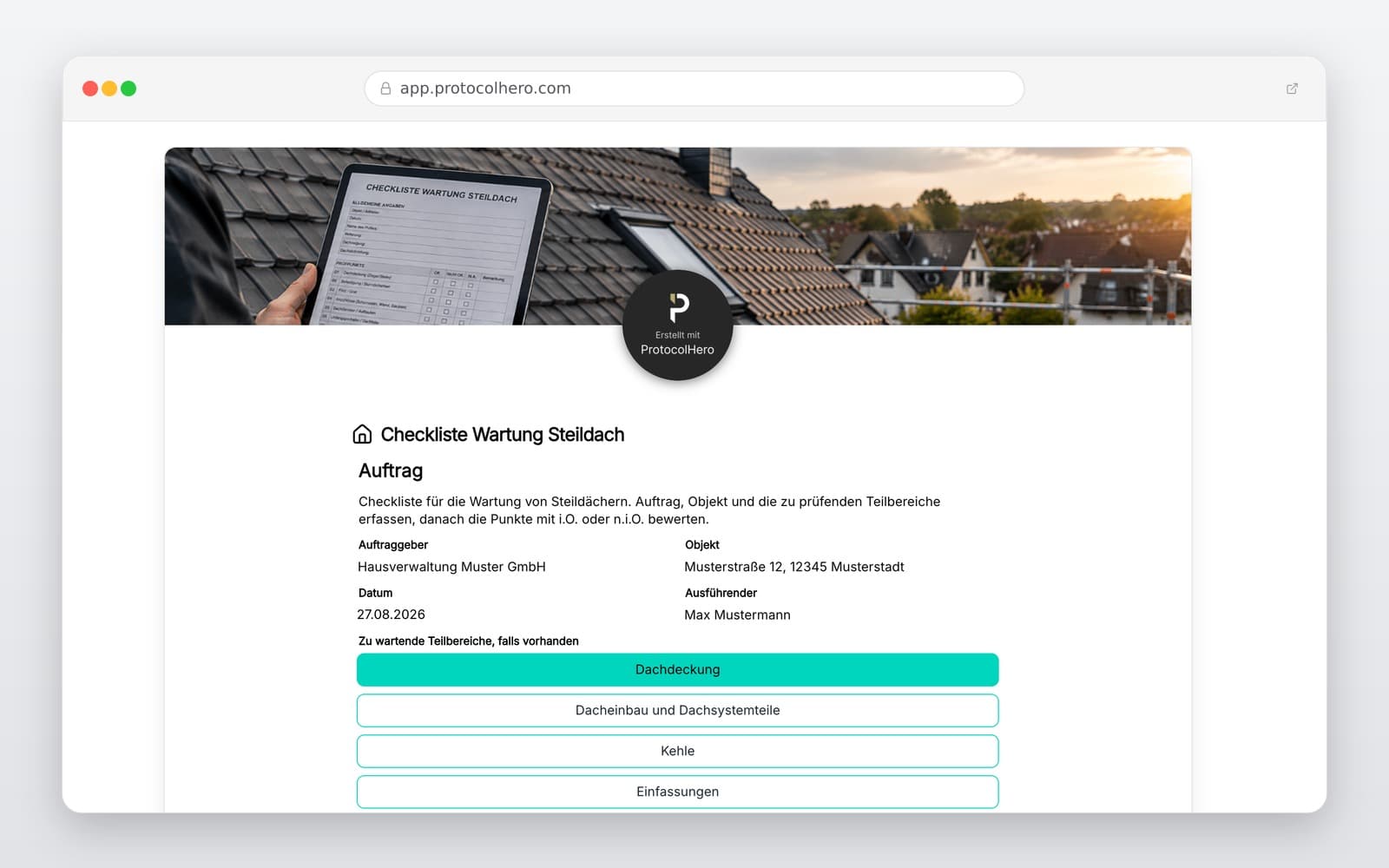
Preview of the “Pitched Roof Maintenance Checklist – Template for Roofers & Property Managers” template
Create free account
Inhalt der Vorlage

What is included in the pitched roof maintenance template?

Object, customer, and roof details

Inspection of roof tiles, slates, or roofing materials

Checking for broken, displaced, or missing elements

Inspection of ridge, hip, eaves, and verge

Checking connections, penetrations, skylights, and integrated components

Inspection of gutters, downpipes, and roof drainage according to DIN 1986-3:2024-05

Documentation of dirt, vegetation, damage, and anomalies including photos

Recording of measures, recommendations, and digital sign-off of the maintenance

Live form

Fill out this template directly in the browser

No install needed — complete the form below, attach photos, and submit. Create a free account anytime to save and reuse your own templates.

Document Pitched Roof Maintenance Digitally Now

Test ProtocolHero for free and create professional maintenance reports directly on-site on your smartphone or tablet.

What is Included in a Professional Pitched Roof Maintenance?

A professional pitched roof maintenance involves far more than a quick glance at visible tiles. A systematic inspection of all functional areas is crucial to detect weak spots early before expensive damage to the building structure occurs. In addition to the actual roofing material, sensitive interfaces such as the ridge, hip, eaves, and verge areas, as well as all connections and penetrations, must be carefully checked.

Special attention should be paid to components that interrupt the closed roof surface. These include skylights, chimney connections, ventilation pipes, and technical installations like solar panels or antennas. Roof drainage is also an essential component: gutters and downpipes must be free of blockages to safely drain rainwater. The current DIN 1986-3:2024-05 standard regulates the operation, inspection, and maintenance of drainage systems for buildings and properties. A complete maintenance log documents exactly which areas were checked, where defects exist, and which measures are recommended.

  • Roofing material: Checking for broken, displaced, or missing roof tiles or slates.
  • Connections & penetrations: Inspection of chimneys, skylights, and ventilation pipes.
  • Roof drainage: Checking gutters and downpipes according to DIN 1986-3:2024-05.
  • Difference from flat roofs: While flat roof maintenance focuses heavily on sealings and water pooling, pitched roof maintenance concentrates on tiles, ridge, hip, and transitions.
Sensitive Weak Points & Precise Defect Documentation

In practice, leaks usually occur at the transitions between different materials and components. Roofing companies and building operators should therefore carefully check valleys, connections to rising components, and the fastening of the roofing. Especially after extreme weather events such as storms or hail, roof tiles can loosen or shift. The roofing trade recommends spot-checking the battening and wind uplift protection depending on the age of the roof.

For legally compliant documentation, precise details are crucial. General phrases like 'roof damaged' are insufficient in case of a claim. Precise localization is much better: 'South roof area – two damaged roof tiles above the skylight'. Supported by an overview photo and a detailed close-up, the damage can be easily located and repaired later.

Avoiding Typical Mistakes in Pitched Roof Maintenance

A common mistake in practice is an incomplete inspection that only looks at easily accessible, open roof areas while neglecting the ridge, hip, or connections. Forgetting the roof drainage or simply collecting unsorted photos without precise localization also complicates subsequent analysis. A pure collection of images without context helps neither the craftsman during repair nor the client during approval.

A professional maintenance report should therefore always follow the structure of 'Defect + Description + Section + Photo + Recommendation'. A typical example from daily roofing practice:

  • Defect: Damaged roofing
  • Description: Several roof tiles cracked or damaged by frost.
  • Section: South roof area, third tile left above the skylight.
  • Recommendation: Prompt replacement of the affected tiles to prevent moisture penetration.
  • Photos: Overview photo of the roof area and detailed photo of the damage.

Digital On-Site Workflow: Faster Documentation with ProtocolHero

With ProtocolHero's mobile app, roofing companies optimize their entire maintenance workflow. The employee opens the pitched roof maintenance checklist directly on their smartphone or tablet on-site. Step by step, object data is recorded, the roofing is evaluated, connections are checked, and the roof drainage is inspected.

If a defect is found – such as leaves and heavy moss growth in the gutter –, the photo is saved directly at the corresponding checklist point. After completing the inspection, the finished PDF report is automatically generated. The tedious transfer of handwritten notes and matching smartphone photos in the office is completely eliminated. This ensures maximum transparency for the client and accelerates the approval of repair offers.

Häufige Fragen

Fragen zur Vorlage „Pitched Roof Maintenance Checklist"

Mehr als eine Vorlage

Was ProtocolHero zusätzlich für dich übernimmt

Eine Vorlage allein ist erst der Anfang – ProtocolHero macht aus jedem Protokoll einen durchgängigen digitalen Workflow mit KI-Unterstützung, Workflow-Freigaben und revisionssicherem Archiv.

HERO Assistant – KI-Chat für Dokumentenerstellung

Der HERO Assistant ist der eingebaute KI-Chat von ProtocolHero. Du kannst per Spracheingabe ein komplettes Dokument anlegen lassen oder ein bestehendes PDF, Foto oder Word-Dokument hochladen – die KI liest die Struktur aus und baut eine wiederverwendbare Vorlage daraus.

Auto-Fill aus Sprache, Foto und Datei

Beim Ausfüllen kannst du das Dokument per Sprachsteuerung diktieren – die KI ordnet die Inhalte automatisch den richtigen Feldern zu. Oder du lädst Fotos, Scans, Verträge, Datenblätter oder Ausweise hoch: Der HERO Assistant extrahiert die Daten und befüllt das Formular vor – du prüfst und unterschreibst.

Foto- und Video-Upload direkt im Dokument

Zu jedem Bauteil, Messpunkt oder Schadensbild kannst du Fotos und Videos direkt aus der App anhängen. Videos sind besonders nützlich, wenn ein Schadensbild dynamisch ist – ein einzelnes Standbild würde den Befund nicht ausreichend dokumentieren.

Kommentare als Aufgaben – intern und mit dem Kunden

Jede Position im Dokument kann kommentiert und als Aufgabe an einen Kollegen, an dich selbst oder direkt an den Kunden zugewiesen werden. Kommentare können wahlweise rein intern bleiben oder im freigegebenen Kundenlink mitgeteilt werden.

Workflow: Bearbeiter zuweisen, Prüfer freigeben

Dokumente lassen sich an Kollegen weiterleiten und können einen festen Prüfer haben, der die letzte fachliche Freigabe erteilt, bevor das Dokument unterschrieben oder an den Kunden geht.

Activity-Log für lückenlose Nachvollziehbarkeit

Jedes Dokument hat einen vollständigen Aktivitäts-Verlauf: Wer hat wann was geändert, kommentiert, hochgeladen, freigegeben, unterschrieben. Das Log ist auf Wunsch auch im Kunden-Freigabelink sichtbar – ideal für Auditoren, Versicherer und Kunden.

Eindeutige Protocol-ID je Dokument

Jedes Dokument bekommt automatisch eine eindeutige Protocol-ID, mit der es sich zweifelsfrei referenzieren, verlinken und im Audit-Trail wiederfinden lässt.

Automatische Berichts-Nummerierung

Neu

Fortlaufende, lückenlose Berichts-Nummern (z. B. Protokoll-2026-001, 002, 003 …) je Dokumenttyp und Kunde – ohne manuelles Vergeben, ohne Dubletten.

Web-Formular & Inbox

Neu

Vorlagen lassen sich als öffentliches Web-Formular auf der eigenen Website einbinden – ein ausgefülltes Dokument landet automatisch in deiner ProtocolHero-Inbox zur Weiterbearbeitung.

QR-Code-Etiketten für Anlagen und Bauteile

Neu

QR-Code-Etiketten pro Anlage, Bauteil oder Abschottung, die beim Scannen direkt das hinterlegte Protokoll, die Historie und alle Wartungs- bzw. Prüfdokumente öffnen.

0 × genutzt

Diese Vorlage in 2 Minuten selbst nutzen

Vorlage übernehmen, an deinen Betrieb anpassen und direkt vor Ort ausfüllen – kostenlos testen, keine Kreditkarte nötig.